Trusted by 250K+ Business Worldwide. Find a Location
Trusted by 250,000+ businesses worldwide across 250 locations delivering uniforms, linens and more. Find a Location Near You



Delivering Excellence Since 2000
Contact Us
What is cooking in your commercial kitchen today? And how safe is it for human consumption?
If you’re not 100% sure, you may want to supervise your food handlers more closely.
Otherwise selling unsafe food will tarnish your food business reputation. Not to mention causing food poisoning to your customers.
Not exactly what you had in mind for your business, right? It is not always easy enforcing discipline and getting your food handlers to follow food safety and hygiene best practices. Neither is it far-fetched. But you should be consistent. Of which you need a follow-through strategy. Here are a few ways:
- Organize in-house refresher training
- Encourage your staff to attend courses run by industry associations
- Incentivize them to complete an online food safety training course
And then share these do’s and don’ts for food handlers with your team. It will help jog their memory about which practices to follow and which mistakes to avoid.
What Are the Safe Food Handling Practices?
All food businesses should comply with the Singapore’s Food Safety Standards. It’s all about making sure the food is uncontaminated before a customer consumes it.
In broad terms, you should keep the following food handling practices in check. Make sure:
- You acquire food from trusted food sources
- Your food is stored and prepared safely
- Your food handlers adhere to personal hygiene rules
Abiding by these rules will keep you safe from hefty fines and also help you grow your business.
Now, let’s dive right in. We’ll first look at food safety tips to practice in your commercial kitchen before we get down to some more common mistakes you’d rather avoid.
1. Remind Your Food Handlers to Adhere to Good Hand Washing Practices
You might want to rethink your hand washing compliance strategy.
Here is what the Singapore Government reported in the year 2018 “In the first 10 months of this year, MOH received 271 notifications of food poisoning incidents, involving a total of 1,768 cases. In the same period last year, MOH got 272 notifications of food poisoning incidents involving 1,265 cases.”
With such statistics each year, there’s a very real chance that your establishment might suffer from a food poisoning incident.
But there is a solution.
For starters, make sure you do your part and create an environment conducive to good hand hygiene.
- Provide easily accessible hand washing facilities at your food premises.
- Ensure these wash stations are dedicated solely to washing hands, arms and face.
- Provide your hand wash stations with warm running water and soap.
- Fit out every wash station with conspicuous signage to remind your staff when and how to wash their hands.
- Make hand drying facilities readily available at each hand washing station.
Now:
Some guidelines advise against the use of air dryers in food preparation areas as the air that is blown from them can cross-contaminate food and working surfaces. Whereas in fact, single-use towels are set apart as the most effective hand drying alternative.
And whichever option you settle on, paper or cloth, it will do the job. However, if you opt for non-disposable towels and don’t want your staff to contaminate the food with them, you’ll have to wash them frequently. Often too frequently.
You will find Alsco Singapore’s paper hand towels and dispensers useful. Here are their sizes:
| Size | 372 x 272 x 135 mm |
|---|---|
[b3_row]
[b3_column lg=”4″ md=”12″ sm=”12″ xs=”12″ ]

[/b3_column]
[b3_column lg=”3″ md=”12″ sm=”12″ xs=”12″ ]

[/b3_column]
[b3_column lg=”3″ md=”12″ sm=”12″ xs=”12″ ]
[/b3_column]
[b3_column lg=”3″ md=”12″ sm=”12″ xs=”12″ ]
[/b3_column]
[/b3_row]
But that’s not all.
You’re still stuck with explaining to your kitchen staff how important it is for them to practice proper hand washing technique. This one can get a bit tricky since the frenetic atmosphere of restaurant kitchens can get your staff to cut corners.
Make things clear. They should NEVER sacrifice a customer’s health and their establishment’s image on account of a time shortage. Instruct them to wash hands with soap and running water whenever there’s a risk of contamination.
Truth is, 20 seconds is not that much.
2. Keep Your Utensils and Surfaces Clean
It’s next to impossible to keep food hygienic at your eatery if you’re reckless about the cleanliness of your surfaces and equipment.
Your food professionals need to be acutely aware of best hygiene practices that will keep microbes at safe levels. This is especially important when handling raw meat that can contaminate other food and work surfaces.
So, it’s critical to train your team to constantly clean food contact surfaces.
Remind them to:
- Use warm water and soap or small amounts of bleach to clean food preparation surfaces.
- Clean utensils such as cutting boards, plates and thongs with warm soapy water.
In fact, you can make the process much easier for everyone if you manage workflows with these precautions in mind. It will save you unnecessary cleaning time. Try organizing it in such a way so that you:
- Handle your raw meats first, clean the worktop and utensils and then transition to other tasks.
- Have dedicated cutting boards for handling raw meat.
- Use a separate set of tongs for raw and cooked meat (when grilling food).
Fairly easy set of rules to follow in any commercial kitchen, right?
3. Keep Foods Out of Temperature Danger Zones
If left unattended for long periods of time food gets susceptible to spoilage. It’s simple. You want to keep your dishes out of the time known as the “Danger Zone”, i.e. when bacteria is most likely to breed.
To illustrate, leave, let’s say, your pork tenderloin at a temperature between 5°C and 60°C. What you’re risking is that the bacteria count in your dish doubles in as little as 20 minutes.
This is the danger zone you want to keep avoiding with the rest of your meals as well.
Keeping food at the wrongs temperatures is one of the most common culprits for a foodborne illness outbreak. And that’s the last thing you want at your establishment, right?
Ensure you store your food at the right temperature, keeping to the general rule of thumb:
- Don’t leave food unrefrigerated for more than two hours.
- If the temperature goes above 32°C, don’t keep the food unrefrigerated for more than one hour.
To top it off, your commercial kitchen staff should know how to treat hot and cold foods. Here are some general guidelines to go by:
- Keep hot food hot. Ensure your cooked food stays at or above 60°C. The most practical way to do this is to serve food immediately. In case you’re catering for an event or you’re serving cooked food at a buffet, make sure to keep it at safe temperatures. Store cooked food in chafing dishes, warming trays, or preheated steam tables.
- Keep cold food cold. Keep cold dishes, such as egg salads, sushi and desserts at or below 4°C. Put them away in the fridge, place it on ice or freeze it.
- Cool hot foods within two hours. Let’s say you’re preparing large amounts of a broth that you plan on using for different dishes later on. Make sure you divide the broth into different containers so they cool more quickly before you refrigerate it.
- Use a thermometer when reheating food. Make sure to keep the internal temperature at around 73°C.
Watch this video for more insights;
What Are the Common Food Handling Mistakes to Avoid in Your Professional Kitchen?
Your professional kitchen staff may think that anything goes if they have a tight cooking schedule. This mindset is exactly what you want to cut off at the root.
Mistakes that creep in due to lack of time, or even knowledge, can be awfully expensive.
According to Yahoo News Singapore, the National Environment Agency (NEA) and the Agri-Food and Veterinary Authority of Singapore are introducing stiffer and tighter penalties to maintain hygiene in food establishments.
A first offender will be fined $10,000 and for a repeat offender a fine of $20,000 and or a three month jail term. That is besides other charges that may be pressed against the offender.
Don’t get caught in such a predicament.
Your staff needs to know basic food handling do’s and don’ts. And this shouldn’t stop at your restaurant kitchen workers. Make it top of your agenda to teach each team member that deals with food directly about safe food handling practices.
Those serving at the counter, waiting at tables and working in the warehouse should all be included.
So, let’s get to it.
Make sure you and your staff are not guilty of the following common food handling mistakes.
Mistake #1 – Letting Your Food Handlers Come to Work When They’re Unwell
For starters, offer some health benefits to your staff members. This way they won’t drag themselves to work if they’re unwell and fear that they’ll lose out on their wages.
This is critically important. If your kitchen staff are ill, it’s very likely that they will transfer harmful bacteria and viruses to food. Contaminating the food means higher chances that your customers will become sick too.
And this is the last thing you want because this can compromise your business.
Send your staff home if they’re suffering from flu, cold or diarrhea symptoms. Or when they have nose and throat infections. They should only return to work when they have been free of sickness symptoms for at least 48 hours.
Or you can delegate other types of work to an employee who is unwell. As long as they’re not working directly with food, it should be okay.
Also, make the following rules a part of company culture in your food establishment. Ensure your food handlers report to the supervisor if they are carriers of microbes that can be passed on through food.
Remind them to report if:
- They have a throat infection followed with fever. Or if they have the following symptoms: diarrhea, vomiting, fever or jaundice.
- They develop infected skin lesions or ear, nose or eye discharges.
- If they become ill with Hepatitis A or have a giardia, salmonella or campylobacter infection.
Mistake #2 – Not Abiding by Recommended Food Storage Times
As we’ve seen earlier, food will develop illness-causing bacteria if left at room temperature for more than 2 hours. But once you’ve put it aside in the fridge or freezer, how long is it safe to keep it there?
Is your kitchen staff 100% positive they know the exact storage times for different types of foods? They need to be savvy in these matters if you’re intending to keep the food you’re serving safe. And you certainly do.
Also, you’ll want to make sure your staff are meticulous in keeping to the recommended storage times.
Keep a watchful eye on raw foods in particular, as they can go off and become unsafe for consumption after just a few days in the refrigerator.
Even if you store food in the freezer, it will still contain bacteria. But they’ll remain dormant and unable to reproduce. The only way to do away with harmful microbes is by processing the foods at high temperatures.
Another important note. Guilty of thawing the food on the benchtop? Instruct your staff not to make this mistake and to thaw the food safely either:
- In the refrigerator
- In cold water
- In the microwave
Take this storage times table and print it out for your kitchen staff members to refer to when in doubt.
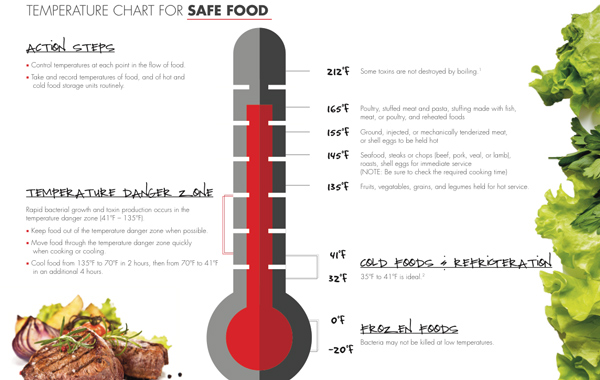
Image from: FoodHandler
Mistake #3 Not Separating Raw and Ready-To-Eat Foods
Do you have staff members that don’t care if they use the same cutting board for raw meat and vegetables without washing up in between? You’ll be wanting to have a discussion with them!
Don’t want to see a food poisoning incident at your food establishment? Let them know that even the slightest contact from raw meat to ready-to-eat food can cause food contamination and poisoning.
And when you know that even chicken packaging has tested positive for Campylobacter, you’ll want to practice extra caution.
So to prevent bacteria from raw meat contaminating other foods, use the following food separation measures.
- Keep raw meat and poultry separate from other foods, especially foods that require little preparation, such as vegetables, salads and prepared sauces.
- Use separate labelled cutting boards for raw meat and poultry, raw produce, seafood, and eggs.
- Use separate utensils when handling raw meat.
- Be careful to wrap any food that is stored in the fridge with tight-fitting plastic wrap.
- Never keep raw meat above other items in the fridge. This way meat-juices won’t drip and contaminate other foods.
Mistake #4 – Undercooking Your Dishes
A word of caution: NEVER take the matter of heat-processing lightly. As with food storage, if you don’t get the temperature right it’s not cooked properly, your food may not be safe for consumption.
So make sure your food handlers use a food thermometer to cook food to a safe temperature. This way they’ll reduce bacteria count to a safe level and the food’s good to go on a serving platter.
Once the food has reached a temperature of 60°C, bacteria starts to die. But different types of foods will require different cooking temperatures. Make sure your food professionals are proficient at those.
- Cook whole beef, pork and lamb meat chops to taste. Of course, provided that the outer crust is fully cooked to kill external bacteria.
- Cook stuffed, rolled, and minced meats as well as meats that are mechanically tenderized or marinated to an internal 75°C. These are high-risk foods since harmful bacteria can be present all the way through. Put the thermometer into the center of the thickest part to check the desired temperature and make sure that the temperature has killed the bacteria.
- Cook whole or minced poultry until it reaches 75°C in the thickest part. These meats are also contaminated throughout and should be thoroughly cooked.
- When reheating leftovers make sure they hit 75°C in the center. Stir them well to ensure the temperature is even.
- Eggs and egg dishes should be cooked until they reach 72°C in the center. This will usually happen when the white firms and the yolk thickens.
Here’s an infographic on cooking meat and poultry.
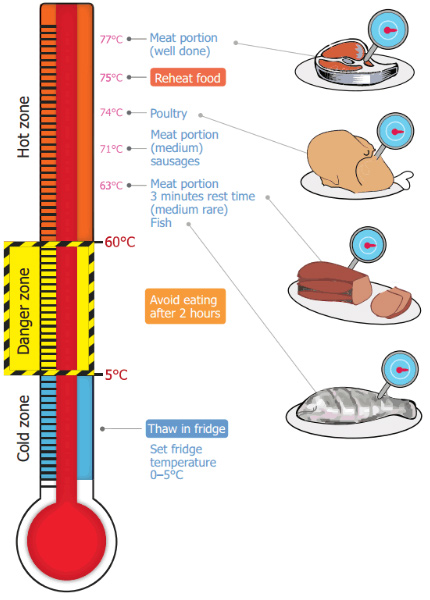
Screenshot from: FoodAuthority
Your Safe and Trustworthy Business
If your restaurant practices safe food handling along with observing proper hygiene, then you will be a safe and trustworthy establishment.
Moreover, you have read all the do’s and don’ts that are associated with food handling. Start implementing them today.
And while at it, you will need a helping hand to ensure stellar hygiene standards. Let Alsco Singapore offer you a hassle-free managed rental service. We’ve helped thousands of businesses in Singapore and you too can benefit.
Our friendly professional staff are ready to help you save time and money. Get in touch today.
Photo: katemangostar
Read More

Five Rules For Restaurant Success

5 Tips To Keep Your Workplace Healthy